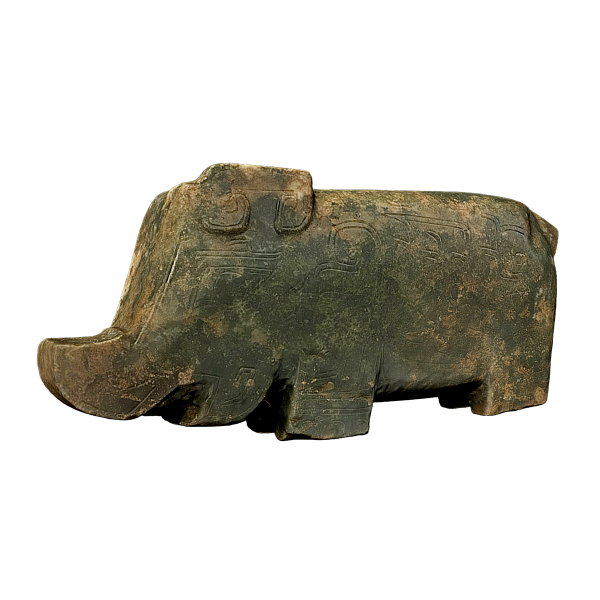
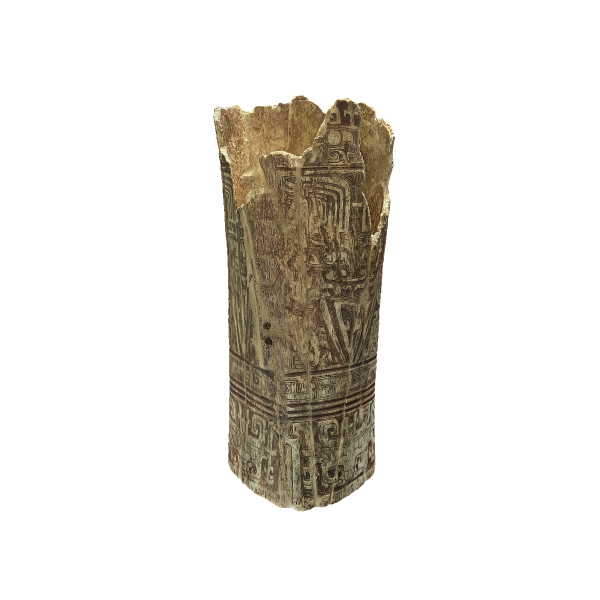
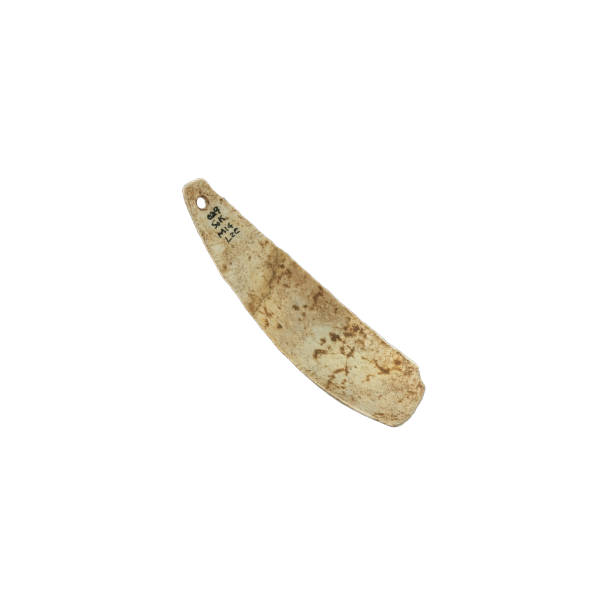
Marble dragon
| Accession No. | R014452_1 |
|---|---|
| Period | Shang Dynasty |
| Material | Stone |
| Findspot | Royal Tomb No. 1500 Hsi-pei-kang, Yin-xu Site |
| Geographic Location | Hou-Chia-Chuang village, Anyang, Honan province, China |
| Dimension | H.15.3cm; L.42.4cm;W:13.7cm |
Description
This marble dragon sculpture, excavated from rammed earth of Tomb M1500 at Hsi-pei-kang (Xibeigang) of the Yinxu archaeological site, was discovered with two groups of three marble animal sculptures arranged head-to-tail: the larger dragon at the front, an ox in the middle, and a smaller tiger at the rear. Their placement is deliberate and largely remained undisturbed except for slight displacement caused by backfill. The sculpture is grayish-white and roughly rectangular with the head being smaller than the body. It appears seated or lying down. The mouth is slightly open revealing bared teeth which extend to the sides. The nose, outlined by incised lines, is positioned above the mouth. The character chen 臣 is incised to form the eyes, which are set further together than those of artifact R014452_2. Behind the eyes are a pair of horns flat against the back likewise adorned with incised lines. The face and sides of the body feature shallow carvings in relief depicting the upper and lower jaws, the muscular structure of the four legs, and the toes, all in a stylized manner. The rear of the body connects to a curled tail, and the base of the sculpture is flat. The form and motifs are relatively simple, with shallow carving and distinct traces of grinding and sanding, markedly different from the intricate style of the animal sculptures excavated from Tomb M1001. As no similar sets of animal sculptures from the same period have been discovered, the meanings of these groupings remain unknown.